



For decades, the National Association of Broadcasters (NAB) has advocated in Washington on issues critical to radio’s future — from protecting AM radio in vehicles to opposing new performance royalties. Now, the organization is backing up that advocacy with new economic data that highlights radio’s enormous contribution to the American economy.
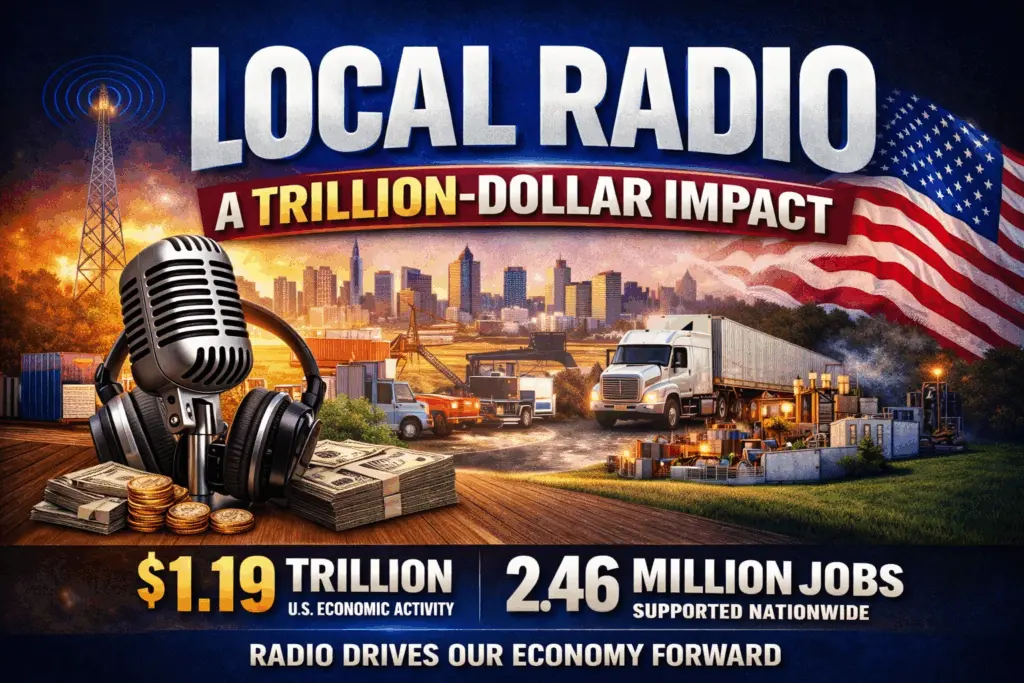
A newly released study conducted by Woods & Poole Economics, Inc., with support from BIA Advisory Services, finds that local radio drives $1.19 trillion in U.S. economic activity and supports 2.46 million jobs nationwide.
NAB President and CEO Curtis LeGeyt says the findings confirm radio’s essential role in American life.
“No other industry gives more to Americans for free,” LeGeyt said. “This report reinforces that broadcasters are not only essential to our daily lives and communities, but to the strength of our economy as well.”
Radio Remains a Major Economic Engine
Local commercial radio alone accounts for $437 billion in annual economic output and supports more than 909,000 jobs across the country. That economic impact extends well beyond station payrolls, fueling growth in industries such as retail, construction, telecommunications, manufacturing, and transportation.
The report breaks radio’s contribution into three major areas:
- $19.8 billion from direct station operations, programming, and advertising employment
- $47.8 billion flowing through supplier industries
- Nearly $370 billion generated by radio’s broader economic stimulation, driven largely by advertising
Advertising Powers Radio’s Economic Ripple Effect
Woods & Poole identifies radio advertising as the industry’s greatest economic multiplier. By efficiently connecting businesses with consumers at no cost to listeners, radio advertising improves marketplace awareness, encourages competitive pricing, and drives consumer spending.
That ripple effect alone supports more than 506,000 additional jobs nationwide.
Radio’s Impact Reaches Every Corner of America
The study shows radio’s influence across every state — from major metropolitan markets to rural hometown communities.
Among the largest state impacts:
- California: $51.4 billion in radio-driven economic activity and over 100,000 jobs
- Texas: $38.9 billion and more than 78,000 jobs
- New York: $31.5 billion and over 61,000 jobs
- Florida: $26.2 billion and nearly 56,000 jobs
Mid-sized states also demonstrate strong radio-driven impact:
- Pennsylvania: $24.1 billion
- North Carolina: $21.8 billion
- Georgia: $17.4 billion
- Michigan: $18.6 billion
Smaller states show particularly strong per-capita results, reflecting radio’s vital role in supporting local businesses, informing communities, and driving hometown commerce.
A Strong Outlook for Local Radio
Looking ahead, Woods & Poole projects stable radio revenue through at least 2028, with local economic contributions expected to grow alongside the broader economy.
LeGeyt says the message is clear:
“Broadcasting is more than a business model; it is a civic model. Radio stands alone in its mission to inform, protect, and uplift every community in America, regardless of ZIP code or income level.”
Why It Matters Locally
From local news and weather to high school sports, community events, and hometown business promotion — local radio remains one of the most trusted and accessible media platforms in America.
And as this study shows, when local radio thrives, local economies thrive.